What 'private' should actually mean
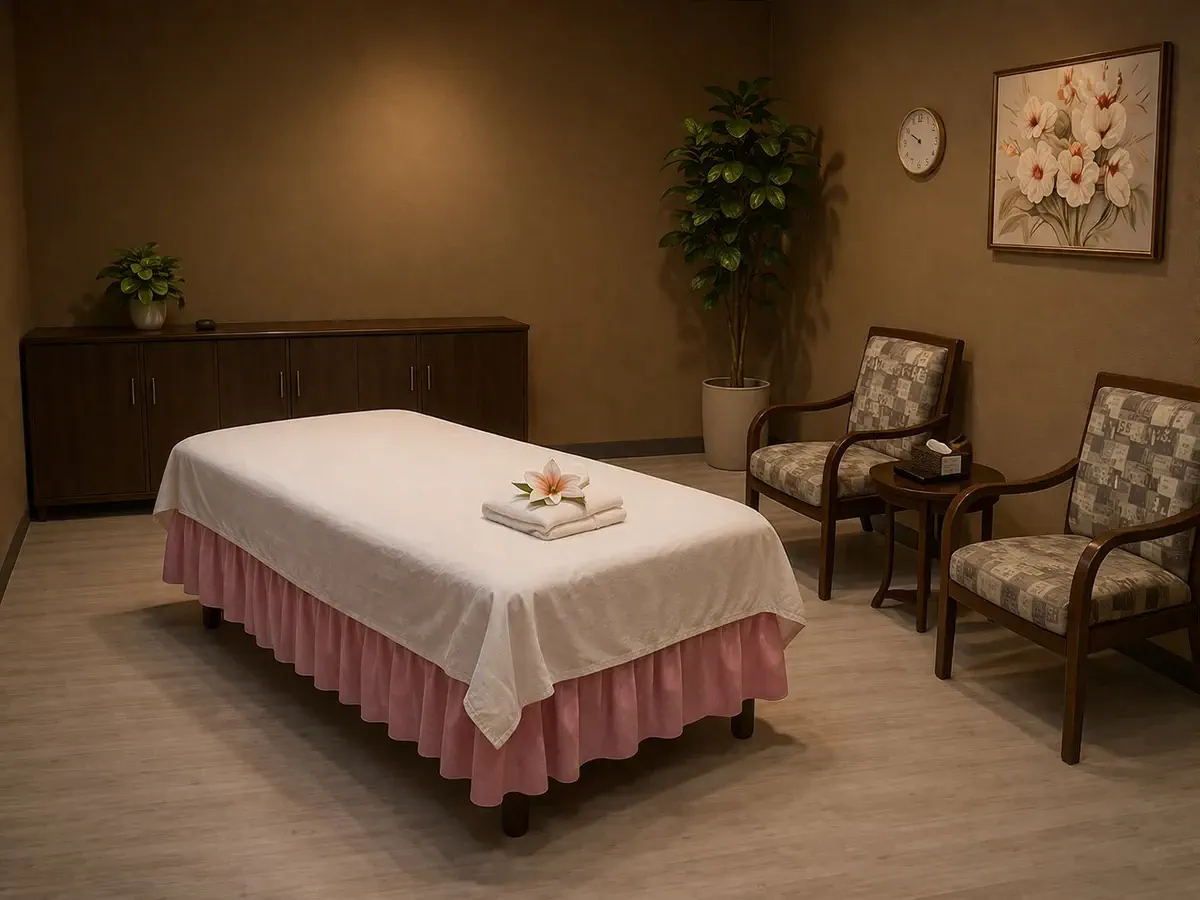
The phrase 'private room' is used loosely in the spa industry. Some places call a space 'private' that is just a curtained-off booth in a larger room. Some call a room 'private' that has a sliding door instead of one that fully closes. At a real private-room spa, the standard is simple: one room, one closing door, one massage table, you and your therapist only. No other guests can hear you, see you, or be in the room. That is the standard at Angel Massage Spa, and we think it should be one standard.
What our private rooms look like
At Angel Massage Spa, the confirmed options are full body massage, oil massage, and stress-relief treatments. Explain your pressure preference and any areas you want avoided when you arrive.
Why room privacy matters
The confirmed session prices are $40 for 30 minutes and $60 for 60 minutes. Availability can change, so call ahead if timing or a visit for more than one guest matters.
What changes between sheets and oil
Linens are changed between every guest, no exceptions. Bed sheets, face cradle covers, and any blankets that touched the previous guest are swapped out. Massage oil is dispensed fresh from a clean pump bottle for each session, not poured from a communal jug. These are basic standards we take seriously — a clean room is what makes a private room actually feel private.
Comparing 'private' levels in the industry
Some chains advertise 'private rooms' but use shared open-plan spaces with curtains. Some use rooms with two tables for two-person sessions. Some use rooms with sliding doors that do not fully close. We do none of those. If you have ever felt slightly self-conscious during a massage because of background noise from another room, the difference at our spa is immediate.
Privacy and body comfort
In a true private room, you change at your own pace, on your own preference. Many guests leave underwear on; some prefer to remove it for full lower-back access; either is fine. The sheet covers everything except the area being worked on at any moment. The therapist works around the sheet, lifting and folding it as needed without exposing you. Your private areas remain covered the entire session.
FAQ
At Angel Massage Spa, the confirmed options are full body massage, oil massage, and stress-relief treatments. Explain your pressure preference and any areas you want avoided when you arrive.
Are there cameras? No. There are no cameras in any massage room.
Angel Massage Spa is at 10716 W Bell Rd, Sun City, AZ 85351 and is open 9:00 AM to 9:00 PM daily. Walk-ins are welcome and private rooms are available.
Is the music adjustable? Yes. Tell us at check-in or in the room — we lower it, raise it, or turn it off entirely.
The confirmed session prices are $40 for 30 minutes and $60 for 60 minutes. Availability can change, so call ahead if timing or a visit for more than one guest matters.
Soundproofing and acoustic privacy
Choose a session length based on the time you have and the kind of relaxing visit you want. If you have a health concern, ask a qualified healthcare professional whether massage is appropriate for you.
We have small space limits — only 4 rooms total — partly because adding more rooms would require larger walls and the acoustic separation we want. We chose to stay small to keep the privacy real.
How privacy supports healing
At Angel Massage Spa, the confirmed options are full body massage, oil massage, and stress-relief treatments. Explain your pressure preference and any areas you want avoided when you arrive.
Guests who have only experienced curtained-booth massage often report that their first session in a real private room feels noticeably different even at the same length and pressure. The setting itself is part of the work.
First-time privacy concerns and how we address them
Common first-time concerns about privacy: 'Will the therapist walk in while I'm changing?' (No — they knock and wait for your verbal okay every time.) 'What if I sleep and they need to wake me?' (They quietly say 'we're done' from a few feet away — gentle, not startling.) 'What if I need to step out mid-session?' (Just say so — we pause without judgment and resume when you return.) 'Can I bring a personal item?' (Yes — there is a bench in every room for clothes, phone, wallet.)
We try to anticipate and answer privacy questions before they become uncomfortable to ask.
Privacy for guests with body-image concerns
Some guests carry body-image concerns into a massage setting. They worry about being seen, about their body shape, about scars or stretch marks or skin conditions. We want to address this directly: a real private room with proper sheet coverage means no one sees your body except your therapist, and the therapist is professionally trained to view bodies as bodies — not as objects of judgment. They are focused on muscles and tension, not on appearance.
If body-image concerns are part of why you have not booked a massage, the private room and skilled sheet handling at our spa removes most of the visual concern. You can also keep more clothing on if you prefer — many guests stay in underwear, some keep on a sports bra or tank top, some wear shorts. The therapist works around any clothing you keep on without judgment.
Privacy and accessibility
Our private rooms accommodate guests with mobility challenges. The doorways are wide enough for walkers. The massage tables can be lowered for easier mounting. We can help with positioning if you have a back or hip condition that makes face-down uncomfortable. Tell us at check-in what you need and we will adapt.
Seniors and guests with mobility concerns benefit especially from private rooms — the slower pace of changing, transferring to the table, and getting situated does not feel rushed when you are not in a shared space. The room is yours for the full length of your session, including the comfortable transitions in and out.
Privacy beyond the session itself
Privacy at our spa extends beyond what happens in the room. We do not share guest names with each other. We do not tell other guests who is in the room next to them. We do not post photos of guests on social media. We do not have an email marketing list — your contact info, if we even have it, is not used for marketing blasts. Whatever happens in your session is yours.
If you have a specific privacy concern not addressed here, ask at check-in or send us a chat on the bottom right. We will tell you our actual practice for that situation, honestly.
Privacy compared to chain spa booth setups
At Angel Massage Spa, the confirmed options are full body massage, oil massage, and stress-relief treatments. Explain your pressure preference and any areas you want avoided when you arrive.
In a real private room with full walls and a closing door, the difference is felt within 2-3 minutes. Sounds drop away. Light is your own choice. Music is at a level you control. Your body knows it is unobserved, and the relaxation goes deeper. Same length, same therapist skill, same price — meaningfully different result. Once you experience the difference, returning to curtained-booth massage feels noticeably less effective.
This is why we hold our small footprint. We could fit more massage tables in the same square footage if we used curtains. We chose not to. Real privacy is the foundation of what makes the session work.
How room privacy affects pressure and therapist focus
Therapists work better in private rooms too. They can focus on your body without splitting attention to monitor what is happening in adjacent spaces. They can speak quietly to you without worrying about being overheard. They can adjust their stance, breathing, and pace freely. Most experienced therapists prefer private-room work for these reasons.
Angel Massage Spa is at 10716 W Bell Rd, Sun City, AZ 85351 and is open 9:00 AM to 9:00 PM daily. Walk-ins are welcome and private rooms are available.
First-visit privacy walk-through
On your first visit, here is how privacy plays out:
1. You check in at the front desk. The conversation is brief and out of earshot of any session in progress. 2. You walk to your assigned room. The door is closed when you arrive — the therapist opens it for you. 3. You enter. The therapist explains the room, points out the bench for your clothes, gives you a moment to ask questions. 4. The therapist leaves and closes the door. You are alone in the room. 5. You change at your own pace. There is no time pressure. 6. You position yourself on the table, under the sheet, face-down with face in the cradle. 7. When ready, you say 'ready' loud enough to be heard through the door. 8. The therapist knocks, asks 'okay to come in?', waits for your verbal yes, then enters. 9. The session proceeds. Doors stay closed throughout. 10. After the session, the therapist leaves the room. You take as much time as you need to dress. 11. You exit when ready. The therapist meets you at the front desk for payment.
Every step prioritizes your control of when and how you are seen.
Privacy as a quiet differentiator
Choose a session length based on the time you have and the kind of relaxing visit you want. If you have a health concern, ask a qualified healthcare professional whether massage is appropriate for you.
The confirmed session prices are $40 for 30 minutes and $60 for 60 minutes. Availability can change, so call ahead if timing or a visit for more than one guest matters.
Ready for your session?
At Angel Massage Spa, the confirmed options are full body massage, oil massage, and stress-relief treatments. Explain your pressure preference and any areas you want avoided when you arrive.
Have a question this article didn't answer? Chat with us on the bottom right →
Closing thoughts
True privacy is one of the simplest things a spa can offer, and one of the most overlooked. Walk in any day from 9 AM to 9 PM at 10716 W Bell Rd, Sun City. Each session is yours, in a real private room, at honest flat-rate pricing. Chat with us on the bottom right with any specific privacy preferences.